
My dad died on July 26, 2026.
He had been in the hospital for eight days. It took the first four to figure out what was wrong and where he was bleeding from. A calcified cyst on his pancreas had grown fistulas that connected to the bottom of his lungs, his diaphragm, and his stomach. One of the arteries in the fistula leading into his stomach began to bleed. Despite every attempt, the doctors couldn’t locate and reach the artery.
He bled to death.
When the ICU doctor finally told him there was nothing more they could do, my dad looked at me, held my gaze, and asked, “What do you think?”
I said, “Dad, if there were anything they could do for you, I would have made them do it over the last eight days.”
It had been hell.
One afternoon after work, I came to the hospital to sit with him for the evening. As I stepped onto the elevator, I heard an overhead page for a rapid response team being called to his room. When I got there, he was gray and shaking. They had him on oxygen, steroids, and a nebulizer.
I thought he was going to die then, but that happened twice.
By the time the doctor finally told him there was nothing left to try, my dad was exhausted. He simply nodded. A single tear ran down his cheek.
Then he looked at the doctor and said, “Just get me some glue, and I’ll fix it myself.”
Earlier this year, when my dad confessed macular degeneration had made it impossible to read, I introduced him to audiobooks. I got him an iPad, AirPods, and we logged into my brother’s extensive Audible library. He spent the next few months leading up to his death happily devouring the entire Mountain Man series by William Johnstone.
I thought this was adorable. My mother, not so much. Somewhere along the way he realized he could leave the iPad next to his chair and wander outside, to the bathroom, to the kitchen table, and never hit pause. I’d call to see how my parents were each afternoon and my mom would say, “Your dad is READING, Jenifer. READING. Thank you so much.” She’d emphasize reading with the vitriol of a woman whose typically quiet husband had decided not to talk at all.
I’d say, “Mom, he’s happy. Leave him alone.” She accused me of spoiling him, always taking his side, and that was probably true.
Dad was my silent constant. I won’t pretend he was perfect, because none of us are, but he was a good, decent, hard-working man. He was quietly funny and wise. In the most challenging passages of my adult life, I liked to just sit next to him outside while he smoked, saying nothing. His presence was enough. I always felt safer with my mountain of a dad.
As a kid, I remember sitting in his lap, holding his hand, thinking it was as big as my brother’s baseball glove. When people new to my life met him, they’d say, “Your dad is a giant.” It always surprised me, but I suppose growing up surrounded by big people left me immune to the shock of a man my father’s height and musculature. In his prime, he could lift anything and tighten tire bolts with his bare hands.
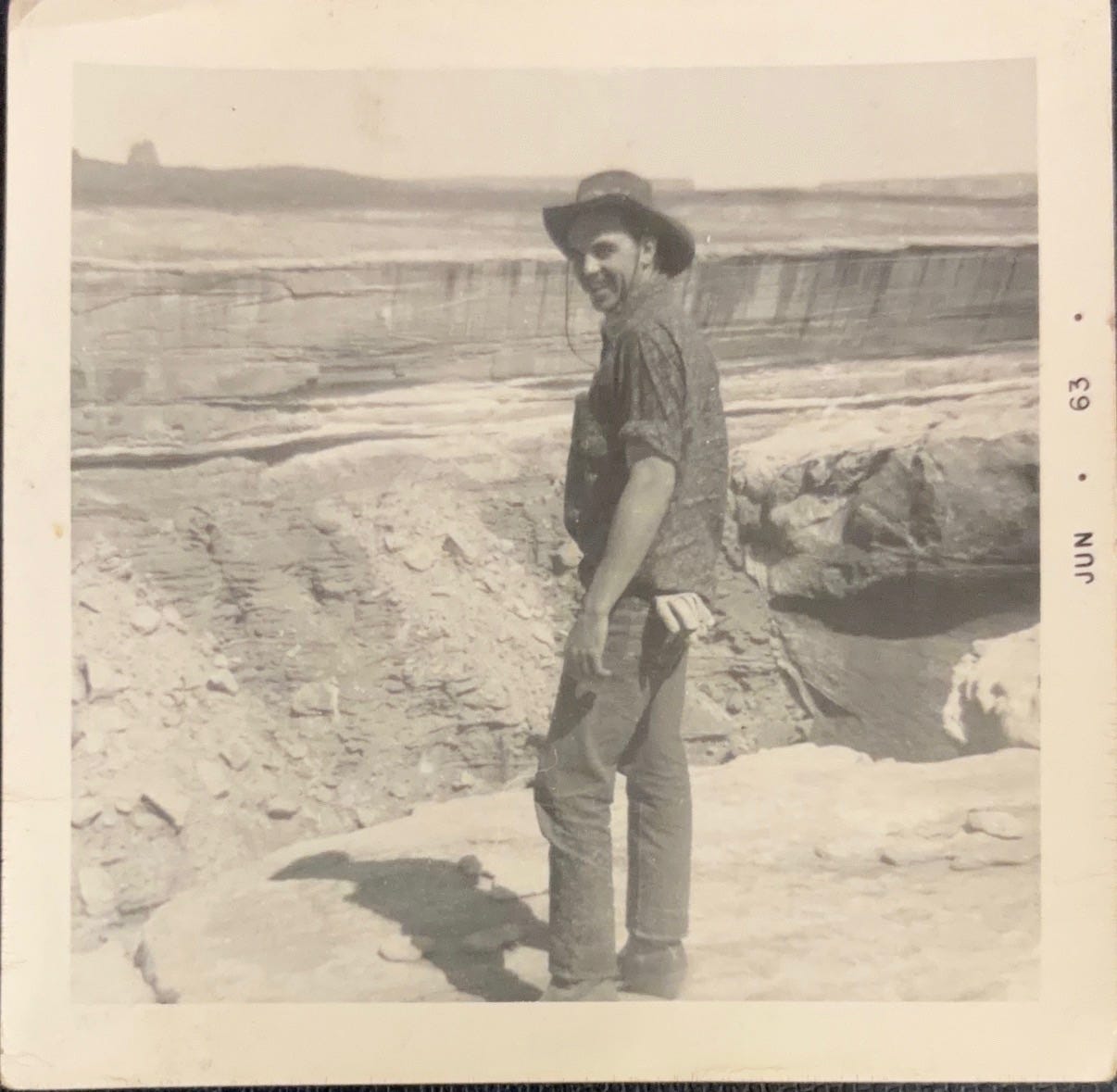
He was a real-life cowboy. He rode bulls and broncos, and herded sheep. He liked sleeping under the stars and didn’t care much about owning anything. He grew up dirt poor on a farm in Elmo, Utah. On the farm, what is real is immediate—animals, crops, weather, and water—and whether or not you had enough of those to survive. This pragmatism informed his consciousness throughout life, and it was rare to see my dad too worried about anything. “It’ll sort itself out,” he’d say, “and it’s all a long way from your heart.”
Once, about five years ago, my mom called worried because she’d not been able to get him on his cell phone. I drove to their house to wait with her, figure out what was going on. I arrived right as he returned home. I parked behind him and he got out of his Ford, closed the door with his hip. He had a gallon of Jack in one hand, a carton of cigarettes in the other, and a Kirkland-size package of ground beef under his arm.
“Dad,” I said, “Mom was worried. Why didn’t you answer her call?”
He shrugged. “I forgot my phone.” Then he waved me into the house behind him. “I just ran to Costco to get my stuff.”
His stuff.
He started refusing additional medical care about two and a half years ago. “I’m just tired of damned doctors.” But we talked him into lubricating injections into his knees to help with mobility.
“Dad, it’ll make getting outside to your bench easier. Can’t hurt. Just try it.” I took him for the first injection.
The nurse said, “Okay, Tom, did you drink plenty of water like we said on the phone?” He nodded and she left the room.
“Dad, you didn’t have any water. Why didn’t you tell me you needed to hydrate? I would have gotten you a bottle for the ride over,” I said.
He shrugged and waved his hand at me. “I don’t drink anything but coffee, milk, and beer.”
“What about the whiskey?”
“That’s medicine,” he said.
I think the shots helped his knees.
My nephew Mick and I kept watch at his bedside through his final night. We pulled two recliners near each other, close together, anchoring one another for the vigil.
Dad ripped the hospital gown off around eleven. Mick insists he was saying, “I am not dying with some sissy gown on.” Probably.
He faded into sleep around midnight and did not wake again to earthly life. The hospice nurse came into the room, every hour on the hour, to give him additional pain medication. Each time, she touched me on the shoulder as she passed, and I’d stand and walk with her.
His breathing was shallow but steady, all through the night.
At five, she wanted to change his sheets and bedding before shift change, and so we stepped out. Mick left to get coffee from the cafeteria. I wandered back into the room. The nurse was waiting for me.
In the time we’d left, his breath had slowed.
“It won’t be long now,” she said, her hand on his shoulder. I walked to her side.
“If you have faith, which it seems you do, he is right here now.” She waved her hands above him.
His breath rattled in his chest, almost ten seconds in between inhalation and exhalation.
“He was waiting to get out until you left. It happens all the time. It’s okay.”
Mick came back then, and I told him. He sat across from me, on the other side of my dad. Tears rolled down his face. My dad’s breathing slowed to once every thirty seconds.
Hebrew scripture describes breath as ruach — the same word used to describe spirit and wind. This is the breath of God, granted to all living things for a time, subject to return to source. Each inhale and exhale expanded and contracted with God’s withdrawal. The force animating my father called him back, breath by breath, until finally, after an agonizing two minutes, we realized there was no breath left to recall.
I sat with my father for a while, opened the blind as the sun rose in the distance. I kissed his head and drew the sheet over his face.
He was no longer there.
Nothing prepares you to be a person in the world where your father no longer lives, and I am on the cusp of fifty and feel too young.
For most of my life, my father’s presence required nothing from me. I could sit beside him outside while he smoked, neither of us saying a word, and know he was there and it was enough.
My mountain of a dad. I’d never considered what it meant to live in a world without him because mountains are not something I’d expect to disappear.
But perhaps grief asks us to learn the difference between absence and annihilation.
His breath returned to God. I watched it happen as the intervals grew longer until the breath that animated his body for eighty-three years was no longer his to hold.
What a privilege to be there when he gave the breath back.
“And the dust returns to the earth as it was, and the ruach returns to God who gave it.”
— Ecclesiastes 12:7, adapted from the Hebrew
Wonderful writing.
Such a beautiful and tender tribute. I’m so sorry for your loss. Love you!