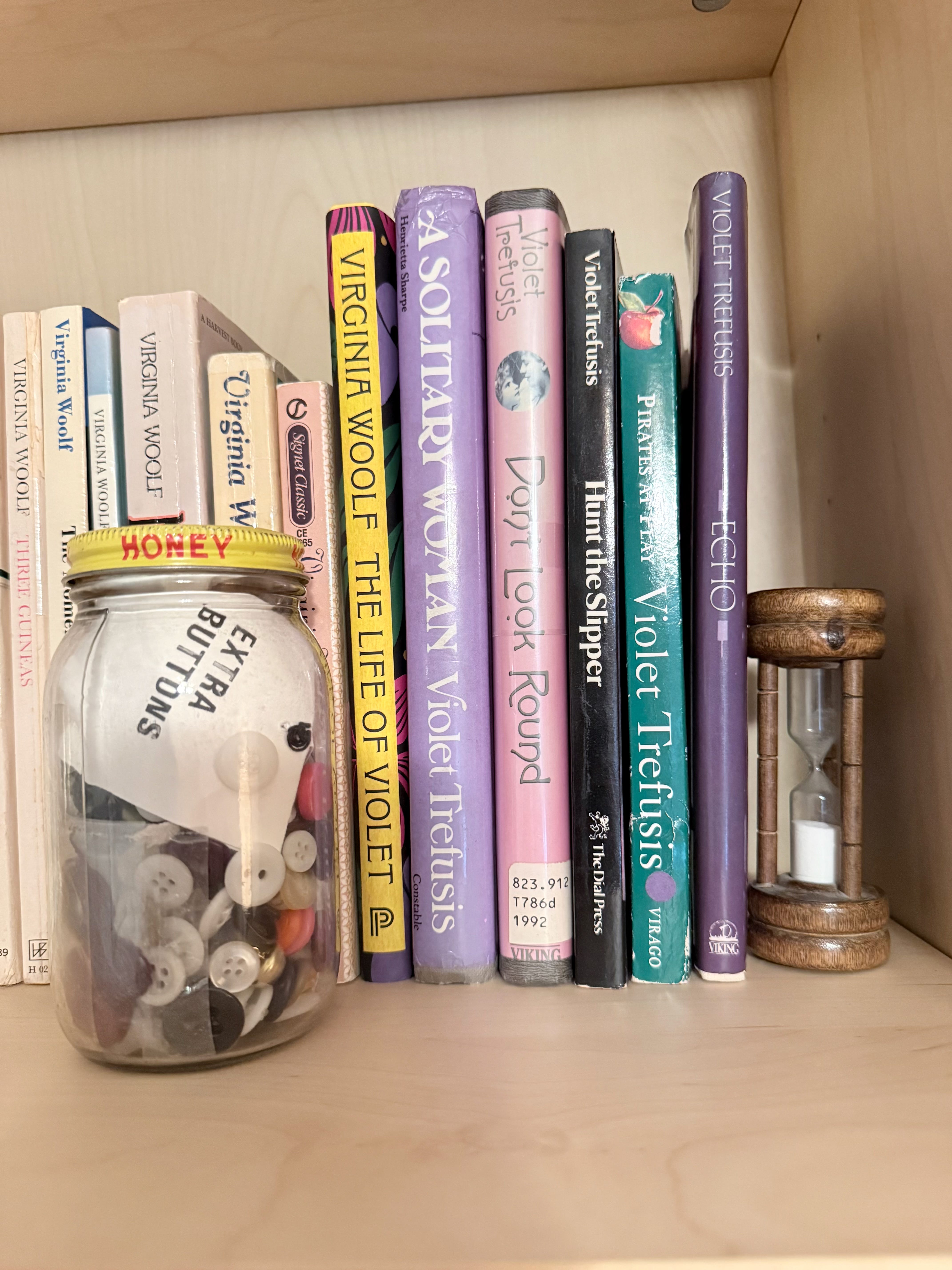
I didn’t mean to become the keeper of Violet Trefusis’ rare editions. But here I am.
Sometime around 2008, I saw the movie Portrait of a Marriage. It was my first exposure to Vita Sackville-West, whom I knew only because she’d had an infamous affair with Virginia Woolf. Virginia went on to write a book about her, Orlando, a beautiful meditation on androgyny.
(Before we go on, imagine having Virginia Woolf write a book about you and still going home to your gay husband. That was Vita.)
For full disclosure, before I begin, I’ll admit that I’ve been in love with Virginia Woolf since I was sixteen years old and first read A Room of One’s Own. Since then, I’ve read every word she’s ever written—fiction, essays, diaries, and letters. Every couple of years I go on a Virginia Woolf bender and re-read them all. On Saturday, I texted my friend Patti and said, “If Virginia Woolf were alive today, would I have a chance?” So, folks, those are the stakes as we continue. (Patti said yes, but she loves me, so the answer is suspect.)
Violet became a character in Woolf’s Orlando, and I don’t think it was fair. It’s only with the benefit of multiple relationships and distance that I understand how unfair. At sixteen, I understood literary glamour. At forty-eight, I understand what it means to be cast as excessive because you are the only one telling the truth. But in Virginia’s defense, Vita probably told her the story.
It’s tragic, and the story leaves Violet looking unstable and unhinged, when she was, among all of them, the most sane.
Let’s set the stage: England, 1918, and Europe was at war. Vita and Violet were childhood friends. Vita’s family was aristocratic. Violet’s mother, Alice Keppel, was the mistress of King Edward VII and the great-grandmother of Queen Camilla.
In this world, an affair was acceptable, so long as etiquette was followed and discretion applied. Violet visited Vita as a young adult and something changed. There are differing accounts of why then. One version suggests Vita felt newly free after Harold Nicolson’s own secrets came home with symptoms, making his sexuality impossible to ignore.
Regardless of the reason, they fell passionately in love.
They traveled across Europe, Vita often dressing as a soldier and passing as male so they could move freely together. This was when the scandal of their affair became too difficult for either family to contain. It was arranged that Violet would marry Denys Trefusis, though she showed him no affection or interest. Vita was sent home to her husband and children.
During this time, Violet and Vita wrote passionate love letters to one another. Only one side of the correspondence survives in full, though, because Denys, in a jealous rage — honestly, the poor guy — burned many of the letters Vita wrote.
They eloped to Paris in 1921, where I imagine they loved life on the Left Bank, surrounded by other queer people. Gay and lesbian clubs thrived openly there. Violet wanted to marry Vita and stay there together. But another intervention from their husbands and mothers broke them up. Vita’s pull toward responsibility was greater than her love for Violet, and she left her there.
I can understand the pressures around Vita without mistaking them for courage. Could they have built a life as an openly lesbian couple in France, with World War II still ahead of them? No one knows. What I know, from all accounts, is that Violet was crushed and never the same. She’d go on to write books and have other affairs, but she was dimmer somehow. Her light faded.
It’s wild to think that it was Violet’s desire to live openly with Vita, marry her, and have her all to herself that was the problem. Not adultery. Not her husband’s discreet affairs with men. Not her mother’s ongoing affair with the King, for crying out loud. Her desire. Her refusal to lie prettily. Her.
I can only imagine that someone who lived in that world with such a desire for authenticity would go a bit mad. That’s exactly how she is described. In fairness, her letters read emotional, dramatic, needy, unregulated. But how could we expect her to be emotionally regulated when the world that was telling her she was the problem was actually the problem? (Said more plainly: everyone else was full of shit.)
There are worlds where sanity looks like compliance. There are families where discretion is mistaken for virtue. There are marriages where the person asking for truth becomes the disturbance, because everyone else has agreed to survive by not naming anything directly.
Anyway, after I saw Portrait of a Marriage, I bought her novels. (Not Vita’s. Never Vita’s. I know I’m being judgey, but she strikes me as an ignoble butch, which is unforgivable.) Not another copy of Orlando. Violet’s.
I wanted to know what she sounded like when she was not being filtered through the people who found her inconvenient. I wanted the woman who wrote after the affair, after the interventions, after the men and mothers and noble families and literary geniuses had finished arranging her into a cautionary tale. I wanted to meet her where she had made something, not where she had been made useful to someone else’s myth.
But flash forward to 2026, when I am cleaning out paper books, sending them to Bookman’s, to the Little Free Library in front of my home, and to the library. I’m doing Swedish death cleaning, though my sister Leigh insists I stop calling it that. It’s only that life is impermanence, my home was too cluttered for too long, I don’t know what comes next, and I want less and less stuff around me. My attention has finally turned to my books.
I can let go of most of them, but I can’t allow Violet to go to a dusty bin at Bookman’s where she might sit next to a weirdly sticky copy of Eat, Pray, Love. This, I realize, is how objects become ethical problems. Not because paper is sacred in itself, but because some books are not merely books. They’re evidence.
Evidence that someone lived and wrote after being reduced to a role in another woman’s legend. Evidence that desire, however inconvenient, had a voice of its own. So, where do I send the books of a woman history has already misplaced?
I began looking for archives. Not because I’m noble, but because I am incapable of letting a dead femme lesbian novelist be mishandled by the used-book economy. We all have our ministries. Some people make casseroles. I manage special lesbian collections, obviously.
Simone Weil wrote that “attention is the rarest and purest form of generosity.” Maybe that’s what I’m trying to offer Violet now: not rescue, not rehabilitation, but attention. The rare kind. The kind that says: you were here, you wrote, you wanted, and we won’t let you vanish into someone else’s myth.
I want these books to go somewhere Violet will be seen. If not, they’ll stay on the shelf— ironically—next to my Virginia Woolf collection.